


Communities & Memberships
We Evaluated 11 Membership Site Platforms. Here's Where Top Creators Are Building
What the fastest-growing creator memberships have in common (and what they avoid)
Author
Mighty Team
Last Updated
July 20, 2026


Table of Contents
Membership businesses are one of the most scalable business models available to modern creators and brands; they combine low overhead with recurring revenue.
But not all platforms are built the same. Some optimize for courses, some for communities, some for advanced marketing funnels. The right choice depends on what you’re building.
In this article, we’ll talk about the platforms that can build great memberships. These membership site platforms have different strengths and weaknesses, but there’s something here for every type of creator and entrepreneur.
We’ll help you pick the right platform for your needs, comparing use-cases, features, and access (e.g. apps).
Quick Comparison - Best membership platforms
Best Features | Use For | Starting From | |
|---|---|---|---|
AI-boosted engagement, courses, livestreams, events, branded apps, #1 G2-rating | Community growth and member engagement | $79/mo | |
Funnels, pre-recorded courses, built-in email and landing pages | Async courses with marketing funnels | $143/mo | |
Spaces for discussions, events, or courses; website builder; email | Simple, space-based communities | $89/mo | |
AI evaluations, quiz builder, affiliate program, order bumps | Selling async courses | $29/mo + 7.5% fee (100 student limit) | |
Strong LMS, AI quizzes, SCORM compliance, website builder | Structured course delivery and advanced assessments | $74/mo | |
Drag-and-drop website builder, integrated email, digital downloads | Website-first creators with simple memberships | $39/mo + 5% fees; $89/mo with no fees | |
Member database, integrated email, event management, automated renewals | Nonprofit memberships and associations | Not public | |
Tiered patron support, simple rewards, built-in discoverability | Fan-supported income | 10% fees | |
Newsletter subscriptions, Notes, recommendation network | Paid newsletters | 10% fees | |
Interactive video, 16 assessment types, AI course builder, SCORM | Advanced course creators needing interactive video | $79/mo + $149–$299/mo for mobile app | |
Simple forum, discoverability engine, gamification | Testing community ideas | $9/mo + 10% fee |
How we chose these membership platforms
We evaluated each platform on the same criteria:
Community and engagement features: whether the platform supports discussions, chat, member profiles, and tools for connecting members to each other, or just delivers content one-way.
Course capabilities: support for live or pre-recorded courses, quizzes and assessments, drip content, and how well courses integrate with the rest of the platform.
Monetization: what you can actually sell (memberships, courses, events, digital downloads, coaching), how flexible the pricing and bundling options are, and how the platform charges.
Branding and customization: how much control you have over the look and feel of your site, and whether a white-label or branded app option exists.
Mobile apps: what the platform gives you for native apps and/or branded apps.
AI and automation: what tools exist for content creation, member engagement, or admin work, and how developed they are.
We also assess who each platform is actually built for, since no platform does everything well.
Best membership site platforms
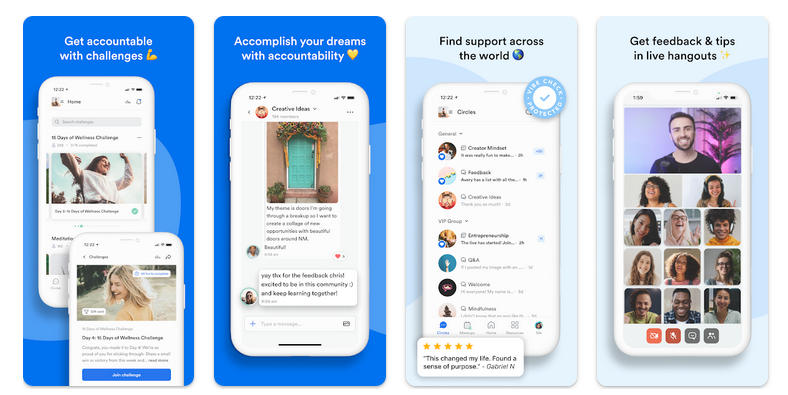
Mighty Networks
Best for membership communities
At a glance: Top-ranked on G2, all-in-one community platform, AI features, built-in events, livestreaming, courses, and branded apps
Price: From $79/month
Who it’s for: Creators monetizing with a membership community at any level, from small groups to branded apps.


Mighty Networks is an all-in-one community and membership site built to connect members to each other, with a mixture of native features and an AI community engine to help boost member engagement.
Core engagement tools include:
Discussions, live streaming, events, courses, chat, and more. You can toggle features on or off as needed.
Smart member profiles (with AI writing assistant), “Show Similarities” tool, and an automatic conversation starter. It can surface members with similar interests, the top members, or members near you.
Gamification with leaderboards, triggers, habit trackers, new member journeys, and auto-unlock rewards (e.g. secret courses, challenges, resources or 1:1 calls).


Sell access to live or pre-recorded courses, livestreaming, virtual events, masterminds, coaching, and more.
Monetize these with memberships and bundles, in 135 different currencies.
Get business intelligence with data on earning, retention, engagement, and even one-click member re-engagement.
Built-in Kit (formerly ConvertKit) and Zoom integrations and over 2,000 software embeds (e.g. Calendly, Drive, Notion, and Loom)
Mighty can build a membership business under your brand identity, with light & dark mode, colors & imagery, customization, & custom URLs. It comes with native Mighty Networks apps, or you can opt for a premium branded app with Mighty Pro.
Mighty Networks features
Pros
Customizable Spaces with livestreaming, events (+RSVP), live and pre-recorded courses, discussion forums, chat & messaging, etc.
Sell memberships, events, courses, private groups, or bundle any of these together
AI engagement tools: automatically generate discussions and course outlines, spark writing, help with profiles, and introduce members to each other
Brand your network or get a premium branded app
Advanced community analytics & reporting
Cons
No website-building features
Missing advanced marketing tools and funnels
Branded apps are a premium offer
Kajabi
Best for async courses + marketing platform
At a glance: Asynchronous courses, course marketing funnels, email integration
Price: From $143/month
Who it’s for: Creators building async, course-first businesses with sales funnels.
Kajabi is a membership site builder that specializes in pre-recorded online courses. It’s well-designed for driving potential buyers through funnels, so its users can market, sell, and deliver their online courses with features like email campaigns, landing pages, triggers, up and downsells, and more.
Kajabi’s funnel templates are easy to use and connect well to emails and landing pages. And the courses are polished and professional, with useful features like dripping content and quizzes. Kajabi has also integrated a native payment engine, which can mean lower transaction fees and faster payouts.
Kajabi is strongest for async courses and marketing funnels, while its community features are less central to the member experience. Its Community 2.0 offers forums, livestreaming, and events, which is a good thing to have–but the UI is awkward. Kajabi added this platform by buying another company, so it’s not fully integrated into courses.
Kajabi's focus is primarily asynchronous content. It does really well with pre-recorded courses, and is best for someone who wants to sell an async course with some minimal member engagement.
Kajabi features
Pros
Powerful marketing engine built-in with emails, campaigns, landing pages, and up- and down-sells
Connect it to emails and customized landing pages
Solid LMS for asynchronous (pre-recorded) courses
AI features for marketing materials and course creation
Good mobile apps for every device and basic branded apps as add-ons
Cons
Kajabi’s starting price point is one of the more expensive options on this list
Weak on community and interactive tools
Managing your business on mobile requires a separate app
Circle
Best for simple, space-based communities with website and email
At a glance: Discussion boards, chat, event hosting, and course features for creators
Price: $89/month
Who it’s for: Community creators who want simple, space-based communities.
Circle is another membership platform that can be used to build communities, run courses, and host virtual events. Circle’s communities are made up of Spaces, and these can divide up your content. Spaces come with access gating, and you can control which members can access which spaces. And Circle has gamification features like leaderboards and points.
The design is clean and simple to use. Circle has added basic website designs, which can be a good option for creators who want a website with community built in. It also has an email marketing tool built-in, with a pay-as-you-go pricing per contact And Circle adds branded apps with Circle Plus.

There are a few important limitations of Circle. It only allows one feature per space; for example, a course and community are in separate Spaces. Circle’s AI tools are also focused on admin tools, with agents that come on Circle Plus; it’s missing the advanced, built-in engagement of competitors.
Circle has some additional fees for extra admins, moderators, spaces, and members once you go above plan limits.
Nevertheless, Circle is a strong, well-designed community platform that gives creators a good set of tools for monetizing communities.
Circle Features
Pros
Easy to use membership platform with spaces for courses, community, or events
Integrated website building and basic email
AI Agents (on the top-tier plan)
Sell or bundle courses, community, and/or events with paywalls
Clean, basic design that’s easy to navigate
Cons
Spaces have 1 feature each
Additional fees for more admins, moderators, members, and spaces.
No advanced member engagement tools
Teachable
Best for asynchronous course sales + AI evaluations
At a glance: Asynchronous courses, AI quiz builder, custom page options
Price: $29/mo + 7.5% transaction fee (100 student limit)
Who it’s for: Course creators with async memberships
Teachable has gained a reputation as a membership site platform for creators and entrepreneurs to run pre-recorded courses. Teachable has an emphasis on multimedia-based content. And with its membership site platform, users can create multimedia lectures, video lessons, offer online coaching sessions, and more.
Teachable’s AI tools are genuinely innovative, with course outline generator, instant quiz building, and multi-language AI translation. Like Kajabi, it has features for order bumps, upsells, abandoned cart recovery, and Buy Now Pay Later. And it has a built-in affiliate program for getting others to sell for you.
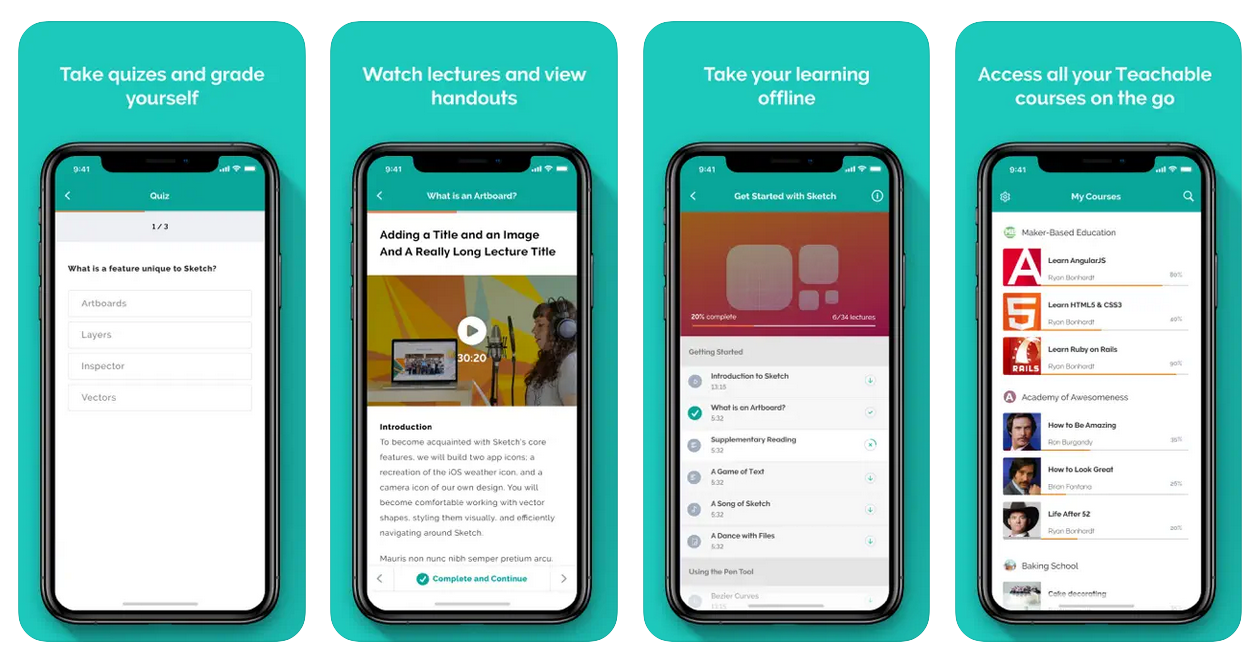
Teachable has a lot of integrations on its platform, and that also means they have a wide variety of currencies that they support. It also has a low starting price of $29/mo, although this comes with a 7.5% transaction fee.
As a membership platform, Teachable is best for pre-set, static memberships without regular member interactions or events. It's missing the depth of features to run live courses, and it can't be used for a robust membership community. It’s an excellent async course platform with basic memberships.
Teachable features
Pros
Good asynchronous LMS with solid content options + AI quiz creator
Landing page builder that’s easy to use + templates
Good marketing options with landing pages, coupons, and affiliate programs
Flexible monetization options
Cons
Limited community functions (basically a forum)
Doesn't work well for a cohort course or live experiences.
No native livestreaming
Thinkific
Best for structured course delivery and advanced assessments
At a glance: Strong LMS and community integration with custom websites Price: $74/mo (for a plan that includes memberships) Who it’s for: Course creators and web-first community building
Thinkific is a course builder with membership capabilities. It’s strongest as an async LMS with some great website functionality, and the added community platform makes it a true all-in-one. For the course platform, it comes with drip content, SCORM compliance, and a quiz-builder that can generate with AI.
The built-in e-commerce tools are strong, with email automation, product bundles, and site building (on the medium-tier plans). And the UX allows for courses and community mostly together, which is clean and intuitive. The customizable landing pages with web templates are great.
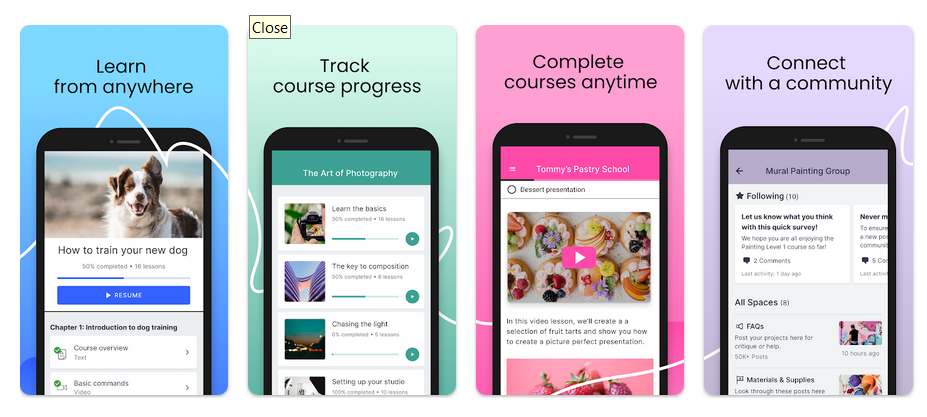
A couple of weaknesses to note. Thinkific has no built-in livestreaming, and the community features are basic. It’s essentially a forum, and note that the membership features don’t come on the basic plan.
Also, Thinkific’s apps are poorly-rated, with widespread reports of glitches, bad UX, and poor functionality.
Thinkific features
Pros
Strong LMS with AI quizzes and flexible delivery options.
Solid website building with some email tools
Good ecommerce tools with a native payment processor (lowers transaction fees)
SCORM compliance on the Plus tier
Cons
Limited community with few real engagement features (missing livestreaming, member matching, and gamification)
Poorly-rated mobile apps, iOS sits at 1.9 stars on the App Store with widespread reports of glitches and broken functionality
Podia
Best for complex website building with simple memberships
At a glance: Course-focused, simple setup, course website builder
Price: $39/mo + 5% fees; $89/mo with no fees
Who it’s for: Website builders with integrated memberships
Podia is a website builder first, with drag-and-drop creation, lots of templates to pick from, and real website functionality. Unlike most website-based options on this list, Podia builds real, multifunctional websites. And it integrates with a lot of great marketing and email tools–the email includes segmentation by products and revenue.
As part of its offer, Podia allows users to create and sell online courses, digital downloads, and memberships. It comes built with some basic features such as webinar and community functions, plus the option to link a community to a course specifically.

The rest of Podia is easy to use. But the membership and digital product features are the weakness offerings, making it a strong website builder with fairly basic membership features. It’s also important to note that Podia has no apps.
Podia features
Pros
Drag and drop website builder with templates and design options
Sell online courses, digital downloads, and memberships
Integrated email with automations
Simple way to add a discussion forum to a website
Cons
No mobile apps
Limited membership features
Wild Apricot
Best membership site platform for nonprofits
At a glance: Full-featured nonprofit websites with forums and event management
Price: Not publicly available
Who it's for: Member-driven nonprofits, alumni networks, and/or associations
Wild Apricot is a membership site platform that caters to membership-based non-profits. If you’re someone who is running a nonprofit organization or a national association, Wild Apricot has developed drag-and-drop tools for creating a website, database management for membership data, and integrated email. Users can also integrate payments and manage virtual events.

Wild Apricot easily integrates with pre-existing systems at your company or nonprofit. It comes with a robust emailing system that can link with your contact list and send out auto-confirmation emails, as well as reminders to your members. On top of that, it has advanced database search capabilities, target emailing campaign functionality, and the ability to track the analytics of your emailing campaigns.
The platform is missing advanced, dedicated community spaces where members can connect and collaborate, as well as features like online courses, livestreaming, and AI options. They do have a CommUnity solution though, which can be added on for an additional price.
Wild Apricot is best for nonprofit organizations, and it offers a 60-day free trial which is far above average.
Wild Apricot features
Pros
Good member management & database features to keep track of people
Integrated email, payments, and automated renewals that make admin easier
Website builder with members-only pages and local chapter sites for national organizations
Comprehensive event management with registration, payments, and QR check-in
60-day free trial
Cons
No courses, livestreaming, or AI; it’s membership only.
Outdated UX and design
Advanced community features require a paid add-on
Patreon
Best for building a group of supporting fans
At a glance: Well-known platform, support tiers, simple rewards
Price: 10% fees
Who it’s for: Creators who want fan-supported income without building a structured product or community
While it takes a different approach to building a membership business, Patreon is a sort of a membership site too. Although fairly limited in features like community options, creating courses, etc., it can be a good place to help members of your audience support you if you’re a creator.
It’s simple to use and easy to get started.
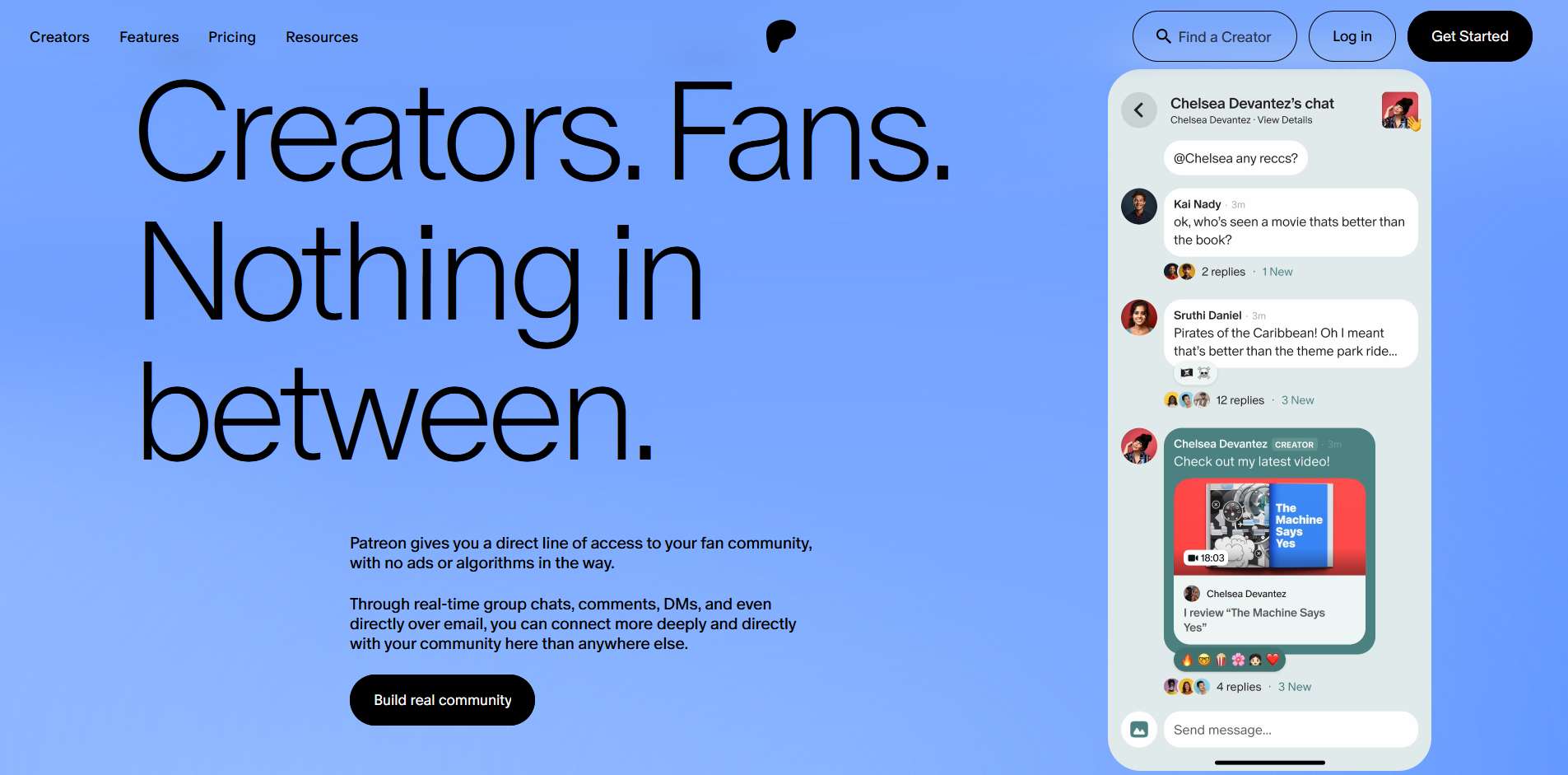
Patreon has simple-to-use tier creation for different levels of support. It has chat, posting, and you can create premium content for different tiers. It has very basic analytics too, so you can see where your growth comes from.
For potential Patreon users, it’s important to understand the revenue structure.
It works on a percentage-based fee. The platform will take 10% of revenue. For example if you have $5,000 in monthly memberships, Patreon would take $500. It's important to be aware of how the fees work.
Patreon is a good membership site platform if you're a creator looking to raise support from your biggest fans.
Patreon features
Pros
Easily sell memberships to your fans
Patreon is well-known and easy-to-use
Great for a patronage monetary model
People can discover you through the platform.
Cons
Limited features for building a real membership business
Often requires integrations with other platforms
Expensive transaction fees
Substack
Best for membership-model newsletters
At a glance: Newsletters with discovery and social media built-in
Price: Substack takes 10%
Who it’s for: Writers, thinkers, and journalists to monetize ideas or podcasts
Substack is a little different from the other membership site platforms on this list. It offers a different type of membership: subscriptions for newsletters.
A creator, often a writer, will create a subscription newsletter that members can subscribe to and receive value in their inbox. As traditional journalism has contracted, Substack has been a really important option for freelance journalists to build and monetize their audience for their work.

Substack is constantly adding features like podcast monetization, chat, and notes. You can add voiceovers for audio-book style experiences. And it comes with street cred–especially for journalists and writers.
Substack is strange because it's a decent membership site platform, but a mediocre email platform. It's missing features that MailChimp or Kit have when it comes to segmenting your audience. And with these two adding monetization options, Substack's place as the newsletter boss might be limited.
But for now, it's a great place to create a paid newsletter, share it with the world, and collect payments. And it looks and feels great for quality reading experiences.
Substack features
Pros
Great for monetizing a newsletter with a built-in subscriber base and payment tools
Substack's recommendation network and Notes feature give genuine organic discoverability
Simple, focused writing experience with no technical setup
Cons
10% cut on all payments, costs grow as you do
Weak email tools compared to dedicated platforms like Kit or Mailchimp, with limited segmentation and automation
No real community features, comments and chat exist but don’t do much.
LearnWorlds
Best for advanced course creators needing interactive video and assessment tools
At a glance: Great LMS & website builder with membership features
Price: $79/mo for the memberships plan + $149-$299 for a mobile app
Who it’s for: Advanced course creators who want a strong LMS and have the budget for additional membership features
LearnWorlds is an excellent course platform. It comes with a powerful LMS with flexible content delivery options and support for live or pre-recorded courses. And it has interactive video tools to add transcripts, viewer interactions, and tagging to its course videos.
LearnWorlds comes with an easy-to-use drag-and-drop website builder that gives you 400+ templates for building course websites. And its built-in marketing tools let you add affiliate programs and sell your courses with sales funnels.
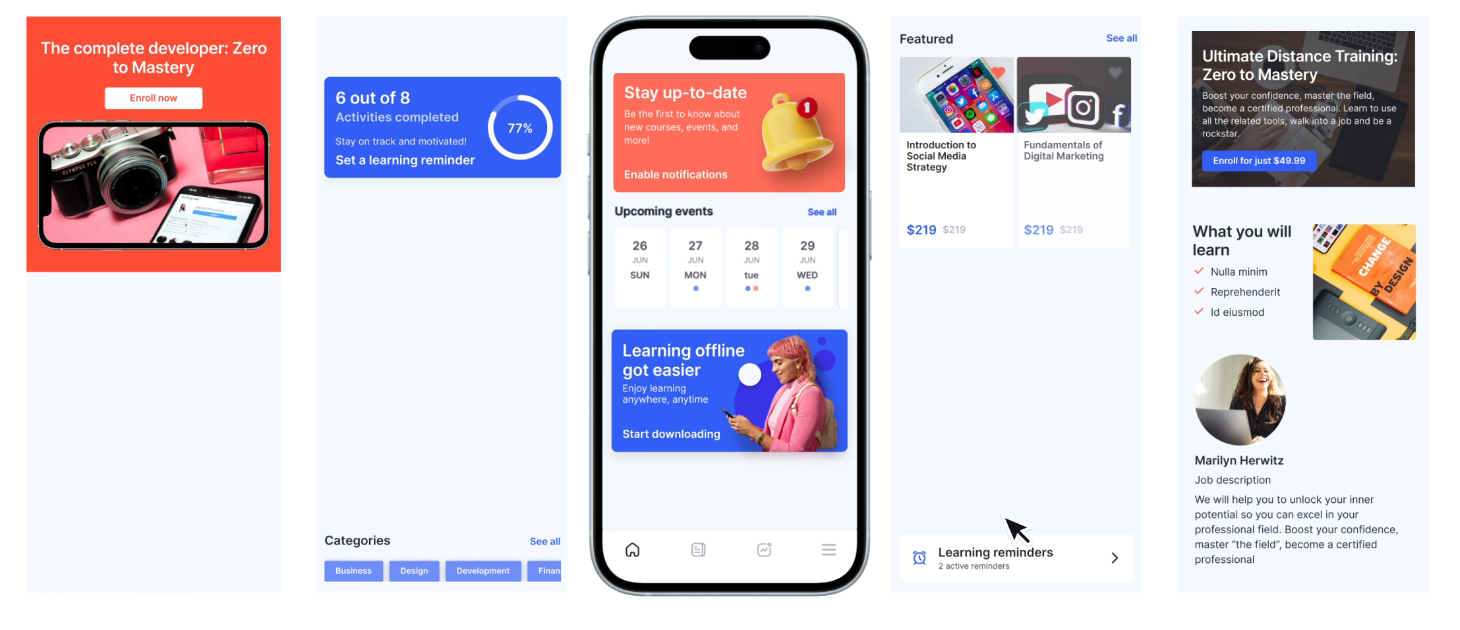
However, LearnWorlds isn’t as strong with membership features. You can organize conversations with private and public spaces, and it has upvotes. But it doesn’t have native video, live events, or native livestreaming.
LearnWorlds also doesn’t have an app included. The only way to get a LearnWorlds app is to pay for their branded app.
LearnWorlds is an advanced product that usually works for institutional clients, but can work for advanced course creators. But its limited membership power is worth knowing about.
LearnWorlds features
Pros
Excellent LMS with interactive videos, 16 assessment types, AI course builder, and SCORM compliance
Strong website builder with 400+ templates, unlimited landing pages, and built-in sales funnels
Cons
The membership site side of LearnWorlds isn’t strong, very limited content options and no native video, livestreaming, or events
No built-in email marketing — requires third-party integrations unlike Kajabi or Podia
Mobile apps are an expensive add-on ($149–$299/month extra) on top of an already premium plan
Skool
Best no-frills platform for testing membership ideas
At a glance: Simple forums with community discovery features
Price: From $9/mo + 10% fee
Rounding out this list is Skool. Skool has gained a lot of visibility thanks to its high-profile ad campaigns featuring internet personalities like Sam Ovens and Alex Hormozi. In terms of the UX, Skool feels like a message board circa the early 2000s. It’s like a running post list and users can comment and like posts. However, you can also add basic courses that are separated by lessons and modules.

Its best features are:
The “discoverability”--people who land on the homepage can find a Skool community to join.
And the “gamification” that gives a leaderboard and level-ups for users based on engagement.
Skool has some real limitations in its design and feature set.
Clunky UX that feels like a simple forum.
No branding or customization power
Skool features
Pros
Simple forum with good discoverability engine & gamification
Widespread name recognition
Low-cost for testing communities
Cons
Bad design and UX
Not built to run large communities
Ready to build a membership site?
If you're looking for a membership site platform to bring members together with lots of native features, come build with Mighty. You can mix courses, content, community, and commerce, and it's the only platform that lets you upgrade to a native mobile app as you grow.
You can try it free for 14 days, no credit card required.
Membership Site FAQs
What is a membership site?
A membership site is a website that offers benefits to members–whether paid or free. These benefits often include content, training, experiences, events, and/or premium offers. Creating a membership site can unlock recurring revenue through paid subscriptions or upsells.
Members are special in a way that “customers” or “followers” aren’t. Members don’t just follow or purchase. Members belong.
A membership site lets you deliver high-value content and benefits to people who pay a monthly or annual subscription. It’s a way for creators to work smarter, not harder, and scale their income potential for their digital business.
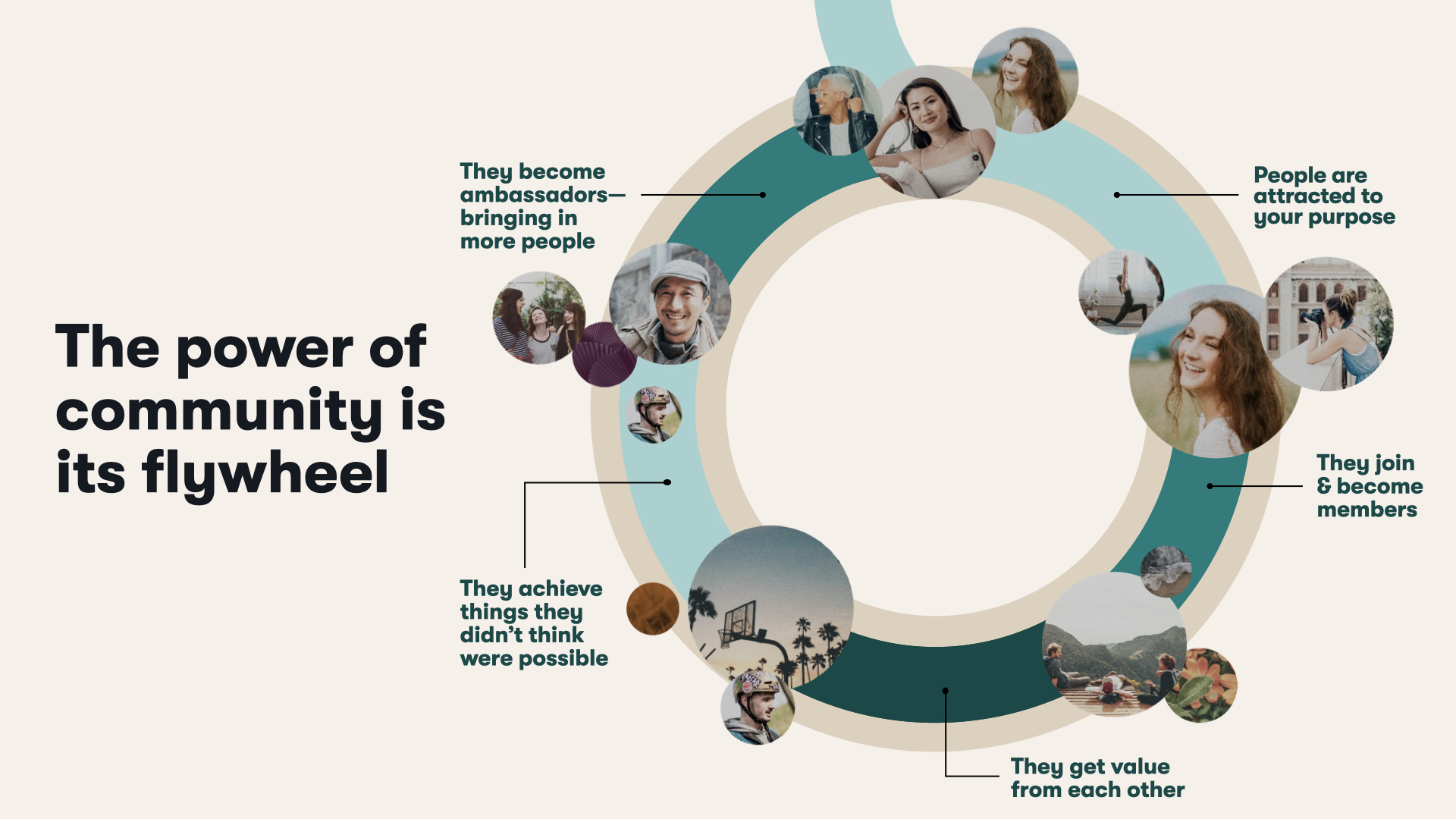
What is a membership site platform?
A membership site platform is the software solution for running a membership site. Most membership businesses run on dedicated applications built by third-party companies (almost nobody builds a membership site from scratch).
Membership site platforms are out-of-the-box solutions that can handle things like member rosters and profiles, discussions and content creation, payment processing and plan creation, etc.
Benefits of a membership site
A great membership site platform can bring some amazing benefits to your brand or business, allowing you to:
Create recurring revenue streams
Scale with minimal extra work. Serve thousands of people at a time with only a few hours of work per week.
Connect members with like-minded people & growth opportunities and a focus they can’t find anywhere else.
Spark user-generated content to put growth on autopilot–use the same principles social media giants do
Bundle memberships with all sorts of goodies like events, courses, coaching, private groups, premium content, and more.
What makes a membership site platform successful?
A good membership platform goes further than a web forum or a Facebook group, giving you the power to own 100% of your digital business. Here's what you should look for:
A way to bring members together & engage on content
Flexible content features that match your style, whether a forum, events, courses, livestreaming, chat & messaging, or polls
A payment gateway that lets you charge in your currency, and options to bundle and sell different kinds of content
A way to build your membership site and make it reflect your brand
Native mobile apps for every device & white-label options
Analytics and moderation features
What features should you look for in a membership platform?
AI-powered tools: AI is helping membership platforms re-define what’s possible for engagement. It can help with content creation–obviously–but also with automated member management, creating amazing member journeys, and helping connect members to each other. For example, on Mighty Networks you can generate community names, course outlines, and icebreaker questions. But members can also use AI to auto-create their profiles, find people who interest them, and start a conversation.
Gamification and engagement tools: It’s not just AI. Gamification features can help you run challenges, automate rewards and unlocks, and show points and leaderboards. These features boost engagement too, making members more likely to show up and learn.
Content features: Most memberships require some level of content creation. Your platform should support what you love to create. For example, writing, speaking, livestreaming, videos, music, events, courses, or questionnaires.
Analytics: Your platform should give you data about both your business and engagement–helping you understand what’s working and what isn’t.
Mobile and white-label apps: Every membership should have app access. It’s the 2020s. Look for great apps for all devices. And–if branded apps are something you’re interested in–watch for those features too.
Monetization power: The ability to sell anything and everything you imagine, natively on your membership platform. Look for multi-currency support, flexible offers and native payments, and the option to bundle things.
Branding: The tools to get the look and feel you want with a brand identity that’s all your own.
What are some membership success stories?
Here are some examples from Mighty Networks’ case studies:
Founded by Chris Lochhead, Eddie Yoon, and Nicolas Cole, the invite-only Category Design Academycharges $1,000/month for small cohorts to create and dominate new categories.
Rick Lewis launched this $2,000/year membership for writers who struggle with fear, writer’s block, and imposter syndrome.
Mike Heroux runs a membership for Canadians ages 50-64 who want to manage their financial planning independently without high advisor fees. It offers financial planning tools, courses, and coaching.
Guitarist John Browne decided to teach metal guitar online, offering master classes, lessons, 1:1 coaching, and an engaged community that plays and practices together.
How much can you earn with a membership site?
Here’s some quick back-of-the-napkin math.
Membership cost of $10-30/month: With 100 members at $20/month, you earn $24,000 annually. Scale to 1,000 members and you're at $240,000/year.
Mid-ticket memberships of 50-100/month: Just 200 members at $75/month generates $180,000 annually.
High-ticket memberships of $200-1,000/month: These memberships, coaching, and mastermind models can earn $120,000-$1.2 million annually with 50 - 100 members.
Which membership site platform is all-in-one?
Several platforms claim to be all-in-one; the key is understanding what's actually integrated versus bolted together. Look for platforms where courses, community, events, and payments share a single login, member profile, and app. Mighty Networks, Circle, and Kajabi all position themselves this way, with different sets of features serving the “all-in-one” label.
How do membership sites differ from social media?
It’s night and day. Here are a few of the main distinctions.
Ownership and engagement: You own nothing on social media. If you get hacked or shadow-banned, you can lose it all. And you fight with the algorithms, competing for attention on a platform that doesn’t care if you succeed.
Monetization: Some social media platforms have built-in monetization options, but not all. And when they do, you’re at their whim and really limited. For example, getting monetized on YouTube requires 1,000 subs and 4,000 watch hours. Moving to a membership site gives you complete control over monetization.
Member connections: Social media throws the word “friends” around, but memberships make it real. Gathering real people around shared goals who can talk and work together actually creates lasting connections.
Focus: An online membership removes distractions and lets members zone in on the transformations and relationships that matter to them.
How do I ensure platform security and data privacy?
Check for:
Payment processing: Make sure your platform works with an established payment processor like Stripe or PayPal–this is better than platforms that directly store credit card info.
Data encryption: Look for SSL certificates (HTTPS) for all pages and check encryption policies. GDPR and privacy: Make sure your platform complies with major privacy and ad-related legislation globally.
Credentials and moderation: Finally, make sure your platform requires user credentials and verification to reduce spam or scams (potentially with 2fa).. And check for content moderation tools to help members feel safe.
Can I use my own custom domain and branding, or will the platform's name appear everywhere?
It depends on the platform. But here are some of the options a good platform should give you:
Custom domains: Run your membership under your own domain name. Bonus point if it’s easy to set up!
Branding options: Add your own colors, logo, IP, and style.
UX customization: Customize your Spaces and member experiences.
White-labelling: Offer your membership on an entirely branded platform or mobile app.
What's the best option for livestreaming exclusive events to paying members?
There are a few ways to get this done.
Native livestreaming (best option): In this case, livestreaming is built right into the platform, and you can instantly go live to all your members. Watch for multi-speaker views (if important), running chat, how members get notified about livestreams, and other options. By the way, it’s nice to have the option to download recordings! Mighty Networks offers this feature with all of these options.
Integrated livestreaming: Some platforms don’t have quite native livestreaming, but have added work-arounds or options. For example, Kajabi bought a streaming platform and branded it under the name Kajabi Community 2.0. It’s a different platform that requires a different app and log-on, but it technically gives a livestream option for Kajabi.
Zoom integration: Some platforms also have a built-in Zoom integration, for running livestreams and/or live meetings.
Embedded livestream (worst option): Finally, some platforms only offer the option to embed a livestream link from another platform like YouTube. These give the lowest customization and delivery options.
Also, keep in mind that you don’t just need the capacity to livestream. You might also want the option to schedule a livestream with RSVPs or perhaps sell access to a livestream. Check the platform for all the related tools.
Ready to start building your community?
Start a free 14-day trial to explore Mighty—no credit card required.
More like this


Join Mighty Community
Learn the principles of Community Design™ (and see them in action) alongside thousands of creators and entrepreneurs. It's free to join!


Online Courses
Creating a Course
Teaching a Course
Course Platforms
Selling a Course
Communities & Memberships
Community Platforms
Managing a Community
Building a Community
Growing a Community
Monetizing a Community
Creators & Entrepreneurs
Monetization
Content Creation
Starting a Business
Website Builders
Creating & Managing a Website
Events
Event Platforms
Hosting & Marketing Events
Branded Apps
Creating a Mobile App
Coaching Apps
Community Apps
Coaching
Mastermind Groups
Starting a Coaching Business
Coaching Platforms
Filter by Category
Online Courses
Communities & Memberships
Creators & Entrepreneurs
Events
Branded Apps
Coaching
Start your free trial
14 Days. No Credit Card Required.